
When I started researching how foreign buyers actually source products from China, I expected the main challenge to be finding the right website. After comparing export marketplaces, a domestic wholesale platform, trade fairs, specialist markets, industry clusters and sourcing intermediaries, I reached a different conclusion: finding candidates is the easy part. The safer method is to use several channels for discovery, then verify the legal company, production route, product specification, approved sample, quality plan, payment terms and import requirements before committing to bulk production.
My first finding was that a supplier profile answers only one question: who is available to contact? It does not prove that the company is the right legal counterparty, owns the factory shown in its photos, can repeat the approved sample at scale, or can make a compliant product for the destination market. The more official platform, registry, inspection and import guidance I reviewed, the clearer the pattern became. Reliable China sourcing means turning a promising listing into a chain of evidence.
Which China sourcing channel should a foreign buyer use?
I began by separating the discovery channels according to what a buyer is actually trying to purchase and how much control the order requires. Ready-made small commodities, export-ready standard products and custom manufacturing projects do not belong in the same search process. Before comparing platforms, I would first decide whether the requirement is an existing product, a modified product or a product made to a new specification.
| Channel | Best suited to | What still needs checking |
|---|---|---|
| Alibaba.com | International B2B search, RFQs, standard products and OEM or ODM conversations | The exact company, factory capability, order specification and the protection written into the platform order |
| Made-in-China.com | Export-oriented suppliers, including industrial and manufactured products | Read the scope and date of any supplier audit, then verify the proposed product and production lot separately |
| Global Sources | Online supplier research combined with category-focused trade shows, especially electronics and lifestyle products | Supplier verification does not certify every product, specification or future shipment |
| 1688.com | China-domestic wholesale search, price discovery and suppliers focused on the local market | Chinese-language communication, payment, export documents, consolidation and international logistics |
| Canton Fair | Comparing many exhibitors and physical samples in a short period | A trade-fair booth is not a factory audit; confirm whether the exhibitor manufactures, trades or uses subcontractors |
| Yiwu, specialist markets and industry clusters | Small commodities, broad assortments or category-specific supplier ecosystems | A market counter or cluster location does not prove ownership, capacity, quality or export readiness |
| Sourcing agent, trading company or direct referral | Buyers who need local language, consolidation, supplier coordination or category knowledge | Fees, commissions, related-party factories, inspection independence and responsibility when something goes wrong |
One conclusion from this comparison surprised me: no channel is automatically direct, cheap or low risk. A good trading company may coordinate several specialist factories more effectively than one factory could, while a bad agent may hide commissions or prevent the buyer from knowing who makes the goods. I therefore stopped treating factory versus middleman as the main test. The more useful test is whether the supply route, responsibility and commercial interest are disclosed.
What are the main websites for sourcing products from China?
Alibaba.com
In Alibaba.com’s own buyer material, I found a platform designed for international wholesale sourcing: buyers can search suppliers, send requests for quotation and place eligible orders through Trade Assurance. Alibaba explains that its Verified Supplier programme includes third-party assessment of defined company and production information. I would use those signals to build a shortlist, but I would still read the assessment report and write measurable requirements into the order.
What I took from the Trade Assurance material is that protection depends heavily on the transaction record. It is strongest when the product description, materials, dimensions, tolerances, packaging, shipment date and inspection evidence are specific. If important requirements sit in an informal chat while the online order stays vague, the evidence available for resolving a dispute becomes weaker.
Made-in-China.com
When I reviewed Made-in-China.com, the most useful difference was not another supplier list. It was the Audited Supplier programme, which publishes reports prepared through third-party inspection organisations. I found these reports useful for comparing registered identity, production facilities, export capability and quality processes before contacting a supplier.
I also found an important limit: an audit report is still a point-in-time assessment with a defined scope. I would check who commissioned it, when the site visit occurred, which address was reviewed and whether the equipment and product category match the proposed order.
Global Sources
My review of Global Sources showed a different combination: online supplier discovery linked to category-focused trade shows, with particular visibility in electronics, mobile, smart-home and lifestyle products. I would consider it when the research plan includes reviewing products online, meeting shortlisted teams in person and comparing several suppliers during the same trip.
Across all three export-facing platforms, I reached the same boundary: supplier verification and product approval are different tasks. A valid business registration does not show whether a battery, textile, toy or electronic device meets the requirements of the country where it will be sold.
Can foreigners buy from 1688?
The most misunderstood channel in my research was 1688. I checked how Alibaba Group describes it and found that it is a China-domestic integrated wholesale marketplace, not an export-first platform. Foreign buyers can still use it for supplier and product discovery, but the domestic-market position affects language, communication, local payment, invoicing, consolidation, export documentation and international delivery.
I found no sound basis for the common claim that 1688 is automatically cheaper. It can provide useful domestic-market price and product comparisons, but the result changes after agent fees, domestic freight, repacking, inspection, export handling, international freight, duty and rejected goods are included. Without a China-side team, I would use a disclosed agent or trading company only after it explains its fee, any supplier commission, who receives the buyer’s money and who is responsible for quality.
Are trade fairs, wholesale markets and factory clusters better than websites?
I then compared online search with physical sourcing channels. The research showed me that fairs, markets and clusters provide information a listing cannot. At the Canton Fair, a buyer can handle samples, compare product ranges and test how well a supplier answers technical questions. In Yiwu, buyers can compare a broad small-commodity assortment and combine goods from multiple vendors. In specialist clusters, buyers can meet factories, material suppliers and subcontractors concentrated around one product category.
My conclusion was that the advantage is speed of comparison, not automatic verification. A booth can belong to a manufacturer, a trading company or a business using multiple factories. A market stall may be excellent at selection and consolidation without owning production. I would still ask for the full Chinese legal company name, business licence, factory address, production role and the name that will appear on the contract and bank account.
For apparel buyers, proximity to materials and specialist processes can shorten development. Our guide to fabric and trim sourcing explains how a visual reference needs to become a controlled material brief before bulk production.
Why do the same-looking products have such different prices?
One of the clearest buyer pain points I found appeared in an ordinary marketplace search. I searched for a folding silicone tray and saw page after page of listings using nearly identical product photographs and overlapping names. On the same results screen, the displayed prices ran from £5.28 to £15.59—almost three times apart—and some listings mixed single-item prices, two-piece pack prices, promotional prices and crossed-out reference prices.
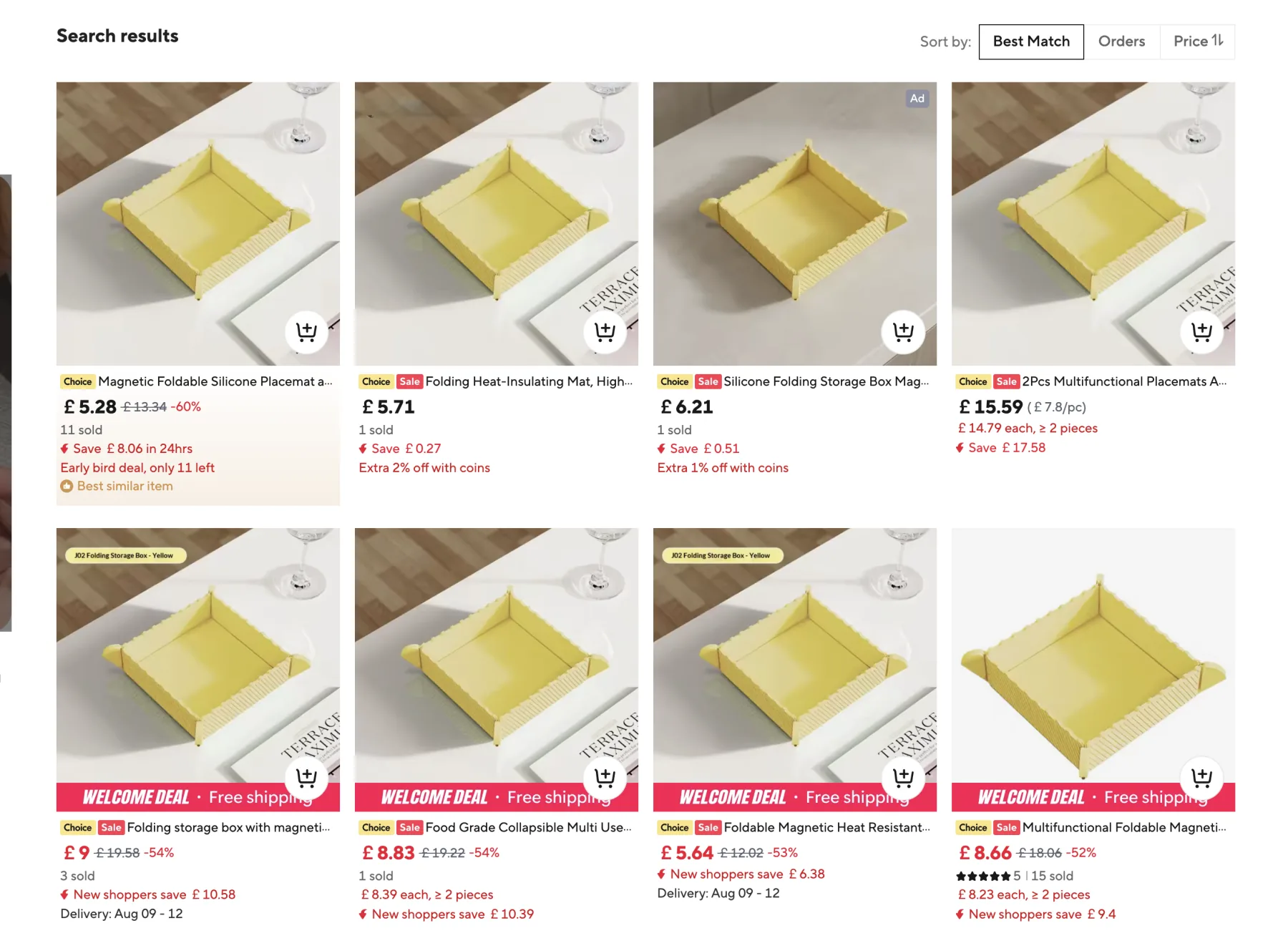
This is where a foreign buyer can feel trapped. Paying more does not automatically buy better material, tighter quality control or stronger factory management. Paying less may mean thinner material, a smaller size, a different grade, fewer pieces, simpler packaging, promotional pricing, excluded freight or weaker inspection. A listing image and product name cannot show which explanation is true.
I therefore would not rank these offers by price until I had normalised the comparison. I would ask every candidate to confirm the exact material and grade, dimensions and weight, piece count, performance requirements, packaging, defect standard, sample basis, production location, inspection plan, delivery term and complete landed-cost assumptions. I would then compare physical samples and evidence against that same brief.
My finding was that value for money has to be verified, not inferred from where a price sits on a search page. The goal is not the cheapest product or the most expensive product. It is the lowest sensible total cost for the agreed material, performance, acceptable defect level, packaging and delivery requirement.
This gap is one reason I wanted Alrightmade to have an independent website. We are not only presenting factory production. Our team combines factory capability with years of product selection and sourcing experience. We can help buyers compare like with like, challenge unexplained price gaps, verify the production route and quality evidence, and find a product whose price and quality fit the real requirement.
Why is finding a supplier only the beginning?
The deeper I went into the sourcing process, the less the website itself seemed like the difficult part. A platform can reduce search cost, but it cannot define the product. Two suppliers may quote the same product name while assuming different material grades, components, tolerances, testing, packaging or defect levels. I found that the lowest quotation may simply include less.
That finding changed how I would compare prices. I would issue the same request for quotation to every candidate, including drawings or a tech pack, materials or composition, dimensions and tolerances, colour standard, workmanship requirements, packaging, labels, compliance tests, quantities, target timing and destination. I would also ask each supplier to list exclusions and assumptions. A comparable quotation is more valuable than a large pile of prices.
How do you verify a Chinese supplier before paying?
From the official registry, platform audit and compliance material, I built four separate verification questions. I would not treat one badge, certificate or video call as an answer to all four.
- Does the legal company exist? Obtain the company’s full Chinese name and unified social credit code from its business licence. Search the official National Enterprise Credit Information Publicity System and check registration status, address, legal representative and any abnormal-operation or serious-violation listing.
- Is this the company you are contracting and paying? Match the legal name across the licence, quotation, contract, invoice and bank beneficiary. Ask for a documented explanation before paying a different company or a personal account.
- Can it control the production? Verify the factory address, equipment, workers, production stages, quality records, current capacity and planned subcontractors. A registered trading company can be legitimate, but it should not be presented as the factory if it is not.
- Can it make this product for this market? Review relevant samples, test reports, certificate scope and production experience. Confirm that evidence covers the actual model, material, facility and destination requirement.
When I checked China’s official enterprise registry, I found a useful but limited source. It is primarily in Chinese, so overseas buyers may need help interpreting it. Registration confirms legal existence, but I would not use it as proof of financial stability, manufacturing capability or future product quality.
Should you visit the factory in China?
My research also changed how I think about factory visits. I found them most valuable when the order involves custom tooling, regulated products, significant deposits, complex manufacturing or a long-term supply programme. A visit can confirm that the site exists and reveal how materials, production, quality control, non-conforming goods and subcontracting are managed.
If I were planning the visit, I would use a written agenda and trace one proposed product from incoming material to packing. I would check whether the equipment is operating, compare stated capacity with visible lines and staffing, review calibration and inspection records, ask where rejected goods are held, and identify which processes leave the site. I would also speak with production and quality staff, not only the sales contact.
The main limitation I found is that a visit is still a snapshot. It does not prove what will happen during production weeks later. When travel is impractical, I would consider an independent factory audit or a live video walk-through, but only if the scope, identity of the site and independence of the reviewer are clear. Our manufacturing network shows the kind of process and handover evidence I would expect a buyer to discuss.
How should product quality be checked before shipment?
When I reviewed inspection guidance and sampling standards, one misconception stood out: quality control does not begin when finished cartons reach the warehouse. I organised the process into four control points.
- Specification review: remove ambiguous words such as premium, durable or standard. Define measurable requirements, defect classes and test methods.
- Sample approval: approve a dated sample and specification together. Record any difference between the sample and intended bulk materials. Keep a control sample where practical.
- Production monitoring: for complex or high-risk orders, check incoming materials and early production before the full lot is complete. This creates time to correct a process rather than only reject finished goods.
- Pre-shipment inspection: inspect the finished, packed lot against the purchase specification before final release or balance payment, according to the contract.
The AQL material produced another important finding. Many inspections use acceptance sampling rather than checking every unit. ISO 2859-1:2026 provides AQL-indexed sampling schemes and acceptance or rejection thresholds for lot-by-lot inspection. I would use sampled inspection to reduce uncertainty, not as a promise of zero defects. The inspection level and defect limits should reflect product risk, while safety-critical features may require testing or controls beyond normal visual sampling.
For material-led apparel orders, use our fabric supplier verification checklist to connect composition, construction, performance claims and test evidence to the exact material being approved.
How do buyers reduce payment, contract and IP risk?
Across platform protection, contracts and payment guidance, I kept finding the same principle: the transaction record must match the real deal. I would use the approved platform order where platform protection is important. For direct contracts, I would choose a payment structure proportionate to order value, tooling and leverage, and verify bank-detail changes through a known contact using a second channel before sending money.
The purchase contract should identify the legal entities, product specification, approved sample, quantity, price, tooling ownership, packaging, testing, inspection, shipment term, delivery point, change-control process, remedies and governing arrangements appropriate to the transaction. Legal advice should be tailored to the parties and markets involved.
The IP guidance led me to another practical conclusion: protection should begin before complete drawings, artwork or mould files are sent. The European Commission’s China IP SME Helpdesk advises businesses to conduct partner due diligence, use contracts and confidentiality provisions, and register relevant rights early. I would treat an NDA as one layer, not as a substitute for registered rights, controlled disclosure, tooling terms and a workable manufacturing agreement.
Who is responsible for product compliance and customs?
One of the clearest findings in my research concerned importer responsibility. A buyer cannot assume that a supplier’s export experience shifts the importer’s legal responsibility to the supplier. Destination-market rules determine the importer’s obligations. The European Commission states that EU importers must verify that products from outside the EU meet applicable safety, health and environmental requirements and that required documentation is available. UK guidance likewise makes businesses that import or sell consumer products responsible for safety and labelling under the applicable rules.
I also found that a low unit quote says little without a full landed-cost model. Before choosing a supplier, I would include samples, tooling, inspection, laboratory testing, packaging, inland transport, export handling, freight, insurance, duty, tax, customs brokerage, storage and defect allowance. I would use an Incoterms rule with the exact named place. ICC’s Incoterms 2020 rules allocate delivery tasks, costs and risk, but they do not replace the product specification, payment terms or sales contract.
Our shipping and delivery guide compares FCA, DAP, eligible DDP and qualifying FOB responsibilities for apparel projects. Buyers should confirm the appropriate route with their freight, customs and tax advisers for each shipment.
What is a practical step-by-step China sourcing process?
Based on these findings, I reduced the sourcing process to seven steps that separate discovery from verification and order control.
- Write the brief. Define the product, quantity, target market, required tests, target timing and commercial constraints.
- Choose two or three discovery channels. Use export marketplaces for breadth, domestic platforms for comparison, and fairs, clusters or referrals for category depth.
- Create a comparable shortlist. Send the same RFQ, then compare assumptions, capability, communication and total cost rather than unit price alone.
- Verify identity and production. Check the Chinese legal entity, payment beneficiary, factory, equipment, subcontractors, certificates and product experience.
- Develop and freeze the approved version. Test samples, record the specification and require written approval for material, component, process or factory changes.
- Contract, monitor and inspect. Connect payment stages to agreed evidence and inspect at the stage where a problem can still be corrected.
- Control shipment and reorders. Confirm the Incoterms rule, named place, documents, import requirements and approved production record before repeating the order.
After organising the research into these seven steps, my core principle became simple: discovery, verification and order control are different jobs. A platform can support all three, but I would never treat a badge from the discovery stage as proof that the production lot passed the other two.
What are the biggest red flags when sourcing from China?
Across the platform rules, audit material and official guidance I reviewed, the same warning signs kept appearing. These are the ones I would investigate before paying a deposit or approving production.
- The company will not provide its Chinese legal name, licence or factory address.
- The contract name, invoice name and bank beneficiary do not match, with no credible written explanation.
- The supplier offers an unusually low price but will not state material grade, components or exclusions.
- Samples are good, but the supplier refuses to freeze the specification or control substitutions.
- Factory photos, videos, audit address and business records point to different sites.
- The supplier will not allow a reasonable inspection, test or live production check.
- Certificates cannot be matched to the product, model, facility, scope or validity period.
- Payment instructions change suddenly, especially to a personal or unrelated account.
- The supplier claims that customs, product safety or labelling are entirely the buyer’s problem while also promising universal compliance.
Frequently asked questions
What is the best website to source products from China?
There is no single best website. Alibaba.com and Made-in-China.com suit many export-facing searches, Global Sources is useful in selected electronics and lifestyle categories, and 1688 can support domestic-market discovery. Choose according to product, order size, customisation, language and export needs, then apply the same independent verification process.
How can I tell whether a Chinese supplier is legitimate?
Ask for the full Chinese legal company name and unified social credit code, then check the official National Enterprise Credit Information Publicity System. Match that entity to the contract, invoice and bank account. Verify manufacturing capability and product evidence separately because registration alone does not prove either.
Is a trading company worse than a factory?
No. A specialist trading company can add product knowledge, consolidation, export service and access to several factories. The risk is undisclosed responsibility. The buyer should know who manufactures, who controls quality, how fees or commissions work and which legal entity is accountable for the order.
Do I need a factory audit for every China order?
No. The level of verification should reflect product safety, complexity, tooling, order value and relationship risk. A factory audit is more valuable for new, custom, regulated or high-value programmes. Repeat orders still need change control and appropriate shipment inspection because a past audit does not approve a future production lot.
Does a pre-shipment inspection guarantee perfect quality?
No. A pre-shipment inspection checks a defined sample or scope against agreed criteria. It can reveal defects and support an accept or reject decision, but it does not inspect every unit unless the contract requires 100% inspection. Product testing, production controls and a clear specification remain necessary.
The takeaway
My final conclusion is that China offers more sourcing access than most buyers can use: international marketplaces, domestic platforms, major fairs, dense industrial clusters and experienced export intermediaries. Access is not the hard part. The hard part is converting a supplier conversation into a controlled product, a responsible legal relationship and a shipment supported by evidence.
Alrightmade applies that discipline to apparel development, materials, manufacturing, quality control and delivery planning. If you have a reference product, tech pack, material target or ready-style brief, send the project details to our team so we can identify the right sourcing route and the approvals needed before production.
What I reviewed for this research
These are the primary sources I used to compare the channels and test the conclusions in this article.
- Alibaba.com Buyer Central: How sourcing works: RFQs, supplier badges, Verified Supplier assessment and Trade Assurance supplier definitions.
- Made-in-China.com: Audited Suppliers: third-party on-site verification and public supplier audit reports.
- Global Sources: 2025 corporate brochure: online marketplaces, supplier verification and category-focused trade shows.
- Alibaba Group: 1688: 1688’s position as a China-domestic integrated wholesale marketplace.
- China Import and Export Fair: Official introduction: the Canton Fair’s role in trade negotiation and supplier discovery.
- Yiwugo: About the official Yiwu Commodity Markets website: online and offline market sourcing, translation, warehousing and inspection services.
- National Enterprise Credit Information Publicity System: China’s official public system for enterprise registration, abnormal-operation and serious-violation information.
- ISO 2859-1:2026: current AQL-indexed sampling schemes for lot-by-lot inspection by attributes.
- European Commission China IP SME Helpdesk: Managing IP in China: business-partner checks, contracts, confidentiality and early IP protection.
- European Commission: Importer and distributor responsibilities: conformity, documentation and traceability duties for products entering the EU.
- UK Government: Product safety advice for businesses: responsibilities for businesses that make, import, distribute or sell consumer products in the UK.
- International Chamber of Commerce: Incoterms 2020: allocation of delivery tasks, costs and risks in international sales.