
Guangzhou’s Zhongda textile district is not a single fabric mall. It is a working sourcing ecosystem: fabric and trim counters, sample rooms, designers, logistics, garment workshops, showrooms and digital trade services operating around the same buyer journey. For a clothing brand, that concentration can shorten the route from a material idea to a production-ready specification. It does not, however, remove the need to verify a supplier, a fabric specification or a production sample.
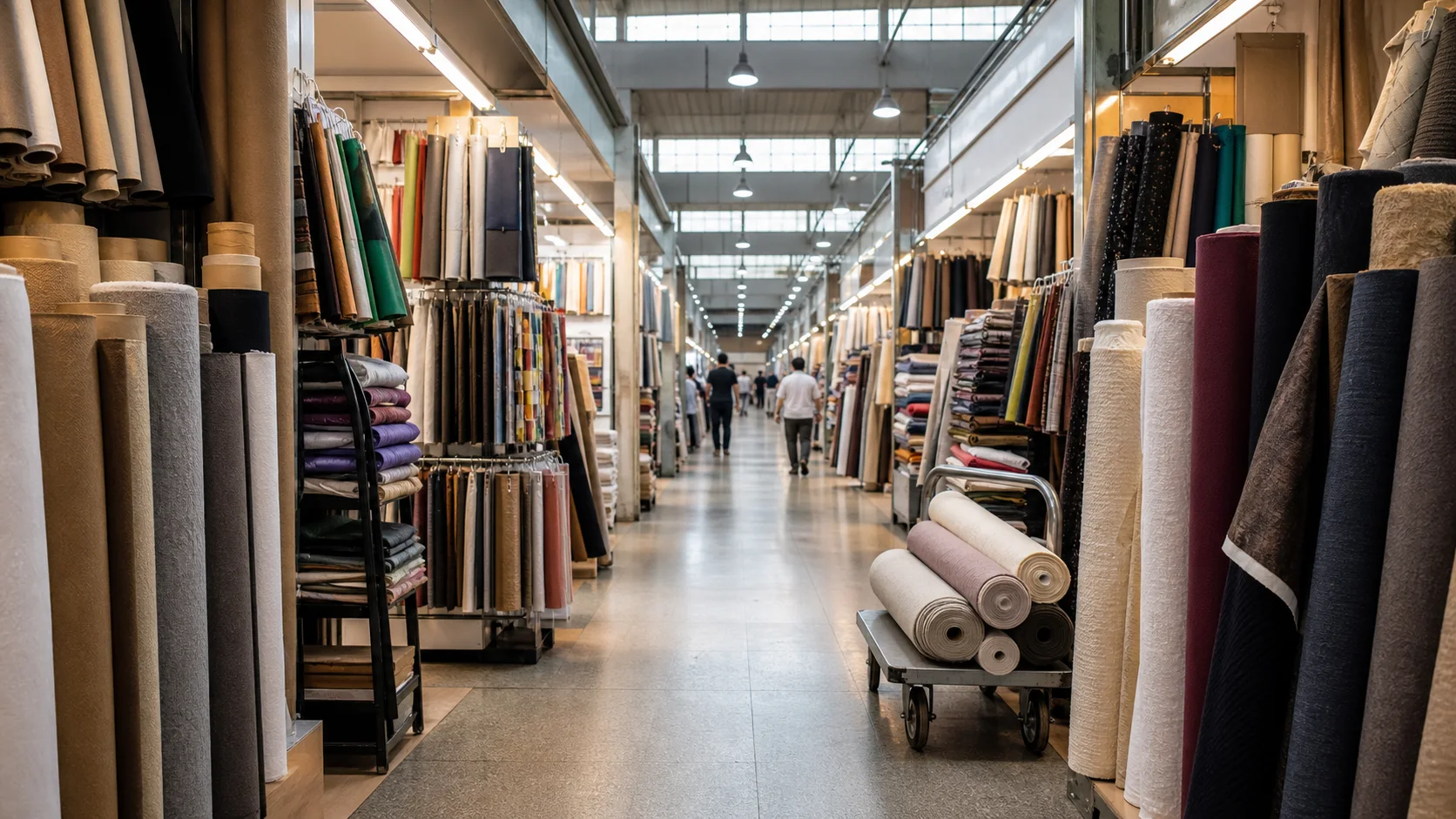
From Guangzhou fabric sourcing to global delivery
Through the Zhongda sourcing network, Alrightmade supports fabric and trim export programmes for clients in the United Kingdom, Spain, France, Italy, the Netherlands, Russia and Poland; the United States, Brazil and Argentina; and the Middle East and Asia-Pacific, including Dubai and the wider United Arab Emirates, Qatar, Indonesia, Vietnam and Thailand.
This is where Guangzhou’s material ecosystem becomes commercially useful. Knit, woven, denim, leather and trim options can be compared close to the development teams, then translated into the composition, hand-feel, colour, quantity and delivery information needed for international sampling and bulk orders. Each export programme is planned around the destination market, product requirements and current freight conditions.
First, separate the district from the building
“Zhongda Fabric Market” is commonly used to describe the textile business district south of Sun Yat-sen University in Guangzhou’s Haizhu District. Guangzhou International Textile City is one important market inside that wider district, alongside Pearl River International Textile City, Changjiang (China) Textile City, Hongmian Zhongdamen and other specialist venues. Guangzhou government reporting calls International Textile City the district’s busiest specialist market.
This distinction matters when a buyer hears a very large number. In a 2022 municipal report, the wider Zhongda district was described as 59 major commercial entities with about 23,000 shops, nearly 20,000 merchants and enterprises, and more than 100,000 product varieties across apparel fabrics and accessories. A later Haizhu District update described 61 specialist wholesale markets, nearly 16,000 merchants and enterprises, direct employment of about 100,000 people, and annual transaction value of about RMB 200 billion. The figures are reported in different years and use different boundaries, so they should be treated as indicators of scale rather than added together.
How much fabric is really there?
The useful answer is not “100,000 fabrics.” The official figure is more than 100,000 product varieties, covering both fabrics and accessories. It can include knitted and woven qualities, denim, shirting, suiting, lace, embroidery, linings, rib, labels, elastics, buttons, zips, hardware and packaging-related items. The same base cloth can also appear in many weights, colours, finishes and availability positions.
For product development, abundance is valuable only when it becomes a controlled choice. A buyer should record the vendor, composition, construction, weight or GSM, usable width, colour reference, dye lot, minimum order, lead time, test requirement and sample cut. A roll that looks right at a counter is not yet an approved bulk material.
Is Zhongda the world’s largest fabric market?
There is a credible basis for calling Zhongda a world-scale textile and apparel-trading cluster. In 2023, a Haizhu District official described the wider Zhongda business district as a leading national and global textile-fabric-and-trim trading base. The district’s own development plan also positions it as a world-class textile-fashion commercial cluster.
But “the world’s largest” is a stronger, comparative claim. We have not found a neutral, like-for-like global ranking that consistently measures every fabric market by the same boundary, shops, floor area, transaction value and product scope. For accurate buyer-facing communication, we prefer: “one of the world’s most consequential textile and apparel sourcing clusters”. It is specific enough to convey scale without turning an official aspiration or market claim into an unverified universal fact.
Why are so many apparel factories and services in Guangzhou and Guangdong?
The answer is history plus density. Guangdong’s early reform-and-opening period accelerated export-oriented light manufacturing, including apparel and textiles. The province’s government notes that textile and clothing were core industries in Guangdong’s early industrial take-off, and that cross-border processing trade helped build an outward-looking manufacturing base.
Today the advantage is less about one factory doing everything and more about a regional network. The China National Garment Association identifies the Pearl River Delta as one of China’s main apparel-production regions and notes that industrial clusters concentrate specialised resources. Guangdong’s industrial plan links Guangzhou and Shenzhen’s trade, exhibitions, headquarters, design and customisation strengths with manufacturing belts across Guangzhou, Foshan, Zhongshan, Dongguan, Huizhou and other nearby cities.
In practical terms, a brand can discuss a fabric in Haizhu, source a trim, send a tech pack to a sample room, visit a garment factory, arrange lab testing or inspection, and connect to freight and export services without treating each step as a separate country or continent. That proximity supports fast sampling and replenishment work, but it is not a substitute for capacity planning, quality control or responsible sourcing checks.
What a buyer should do with this advantage
- Start with a tech pack. Bring intended use, target price, measurements, colour standard, artwork, quantity and delivery window. Do not source by visual similarity alone.
- Ask for a real material record. Confirm fibre content, construction, GSM, width, finish, shrinkage, colour availability and replenishment potential.
- Separate a market trader from a mill or factory. A trading counter can be a strong sourcing partner, but it is not automatically the producer. Trace the supply route before making claims about origin, compliance or capacity.
- Approve a cutting and a sample before bulk. Hand-feel, opacity, recovery, wash behaviour and print compatibility need a physical check.
- Build a backup option. Record an alternative quality or supplier for key materials, especially where colour continuity or seasonal availability matters.
The takeaway
Zhongda’s real value is not that a buyer can see everything in one day. It is that the district compresses discovery, comparison and supplier conversations into one connected sourcing environment. Used well, that can make an apparel programme more responsive. Used casually, the same abundance can create inconsistent materials, unclear accountability and costly sample rework.
Alrightmade uses material sampling, documented specifications and pre-production approval to turn market discovery into a controlled manufacturing decision. Discuss a fabric-sourcing brief with our team when you are ready to move from reference to sample.
From market access to material development
Alrightmade works with independent fabric, trim and leather specialists across Guangzhou and the wider Guangdong supply chain. The network includes long-established, often family-run businesses with development teams experienced in the performance, outdoor, contemporary-fashion and leather-goods segments. Their value is not a pre-set material route; it is the ability to discuss a brief, develop or locate appropriate options, and move a buyer from swatch to verified sample with clear commercial information.
Being close to these partners can improve the working rhythm of a project: faster swatch review, more direct discussion of composition, hand-feel, colour and finish, better visibility of availability, and earlier cost feedback. For leather and leather-goods projects, it also makes it easier to compare grain, temper, thickness, finish, colour continuity and suitable backing or reinforcement before sampling.
Every client programme is developed from its own brief, requirements and approvals. Materials are independently selected for the project, then confirmed through the agreed specification, sampling and testing route before bulk production. That keeps the focus where it belongs: on the material performance, design intent, timing and cost targets of the collection being developed.
Research notes & sources
- Guangzhou Municipal Government: Zhongda textile business district resumes operations (2022): district components, 59 commercial entities, about 23,000 shops, nearly 20,000 merchants/enterprises and 100,000+ product varieties.
- Guangzhou Municipal Government: Zhongda Textile Business District development outline (2023): official positioning, digital trade, design, flexible manufacturing and supply-chain development.
- Haizhu District Government: Zhongda textile business district’s development (accessed July 2026): 61 specialist markets, nearly 16,000 merchants/enterprises, 100,000+ product varieties and approximately RMB 200 billion in annual trade.
- China National Garment Association: Overview of China’s Garment Industry: Pearl River Delta apparel concentration and the role of specialised industrial clusters.
- Guangdong Provincial Government: textile and apparel cluster strategy: Guangzhou and Shenzhen’s fashion/trade role and Guangdong’s regional apparel belts.