
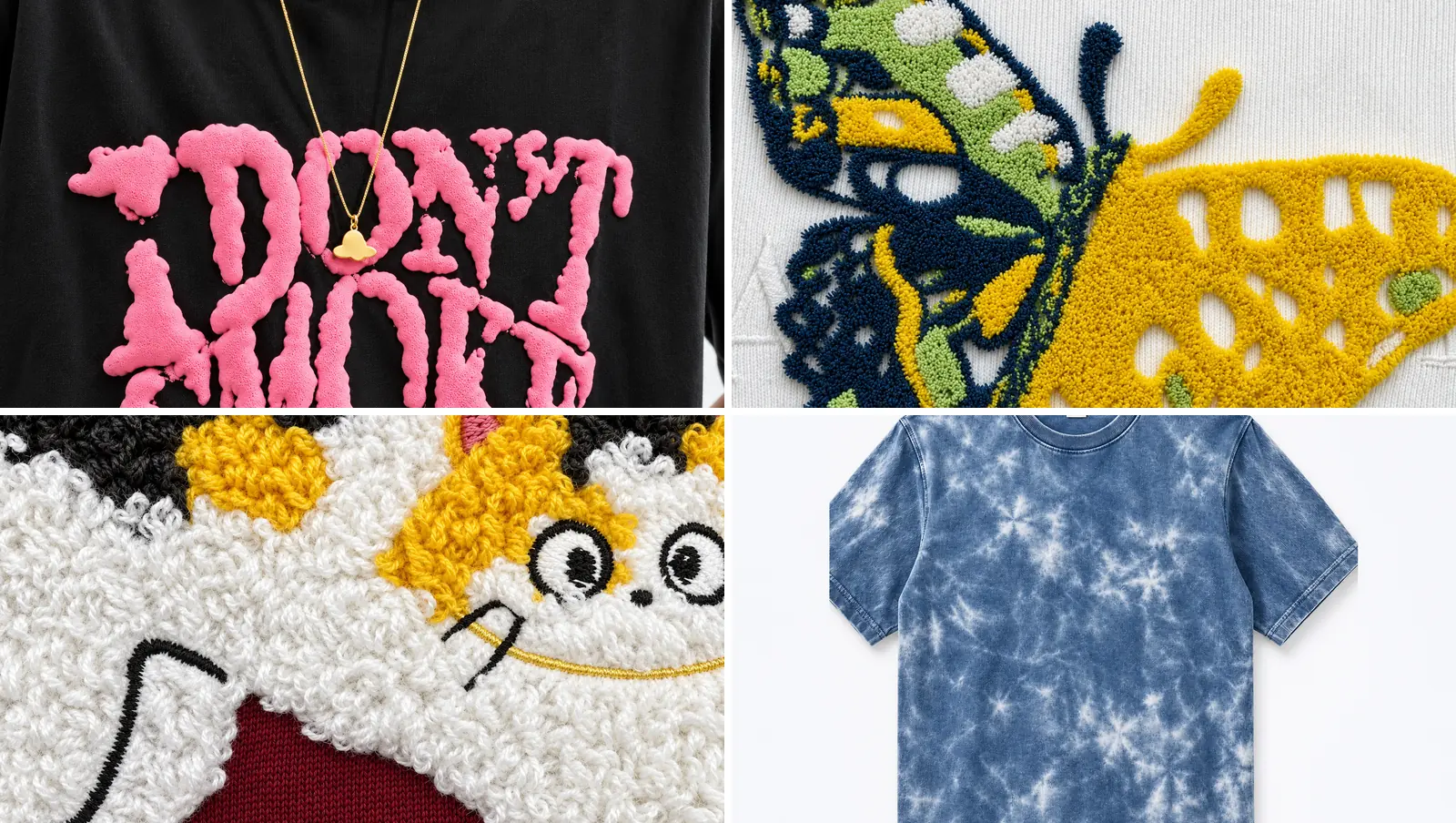
The right garment decoration method depends on five things: the artwork, the garment colour and fibre, the handfeel you want, how many pieces you are ordering, and whether the garment will be washed after decoration. Get those five right and the choice usually narrows to one or two methods before you ask for a quote.
This article is the decision guide. For a plain description of every method, with photos, see our garment printing, embroidery and wash techniques guide.
Quick answer: which method suits which job?
| If you need… | Start with | Why |
|---|---|---|
| A bold logo in 1–4 flat colours, repeated over many pieces | Screen printing | One screen per colour; cost per piece drops as quantity rises |
| A photo, gradient or many colours | Direct-to-garment (DTG) print | No screens, so colour count does not change the set-up |
| Strong, accurate colour on a dark garment | Rubber (plastisol-type) print | Opaque layer covers the base colour |
| The softest print on a light garment | Water-based print | Ink soaks into the fibre instead of sitting on it |
| A soft, faded print on a dark cotton garment | Discharge print | Removes the dye rather than adding a layer; 100% cotton only |
| Raised texture without stitching | Puff print or a high-density print | Puff is rounded and soft; high-density has crisp, sharp edges |
| A premium, long-lasting logo | Embroidery, such as raised satin | Thread does not crack or peel |
| A lived-in, vintage garment | A garment wash such as a salt or a snow wash | Fades the whole garment, and any print on it |
Screen printing vs DTG: which is better for a clothing brand?
Screen printing is usually better for simple artwork in larger runs; DTG is better for detailed, many-colour artwork and for testing designs. Screen printing pushes ink through a mesh screen, one screen per colour, so a four-colour design needs four screens before the first piece is printed. That set-up is spread across the order, which is why screen printing gets cheaper per piece as quantity grows.
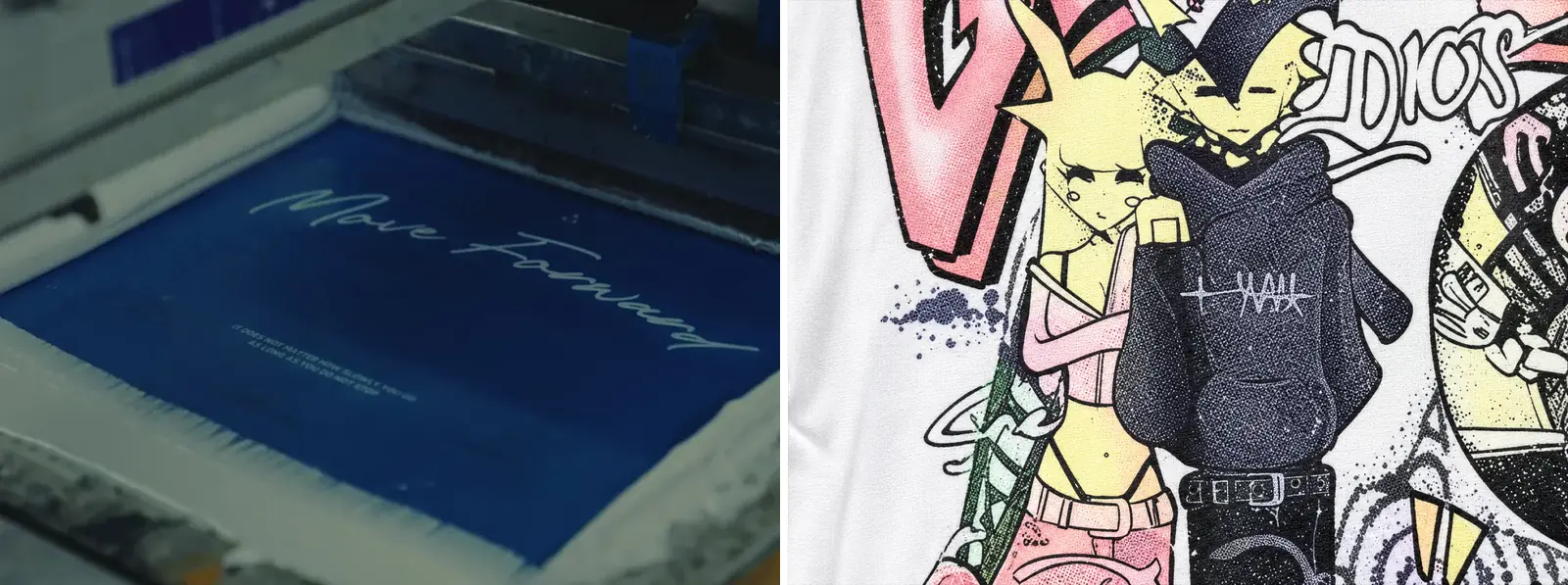
DTG prints the artwork straight onto the garment like an inkjet printer. There are no screens, so a photograph costs the same to set up as a one-colour logo. The trade-offs are fibre and colour: DTG performs best on high-cotton fabrics, and dark garments need a white base layer under the colour. Always approve a printed sample on the actual blank, because the same file can look different on two fabrics.
Which print works on dark garments?
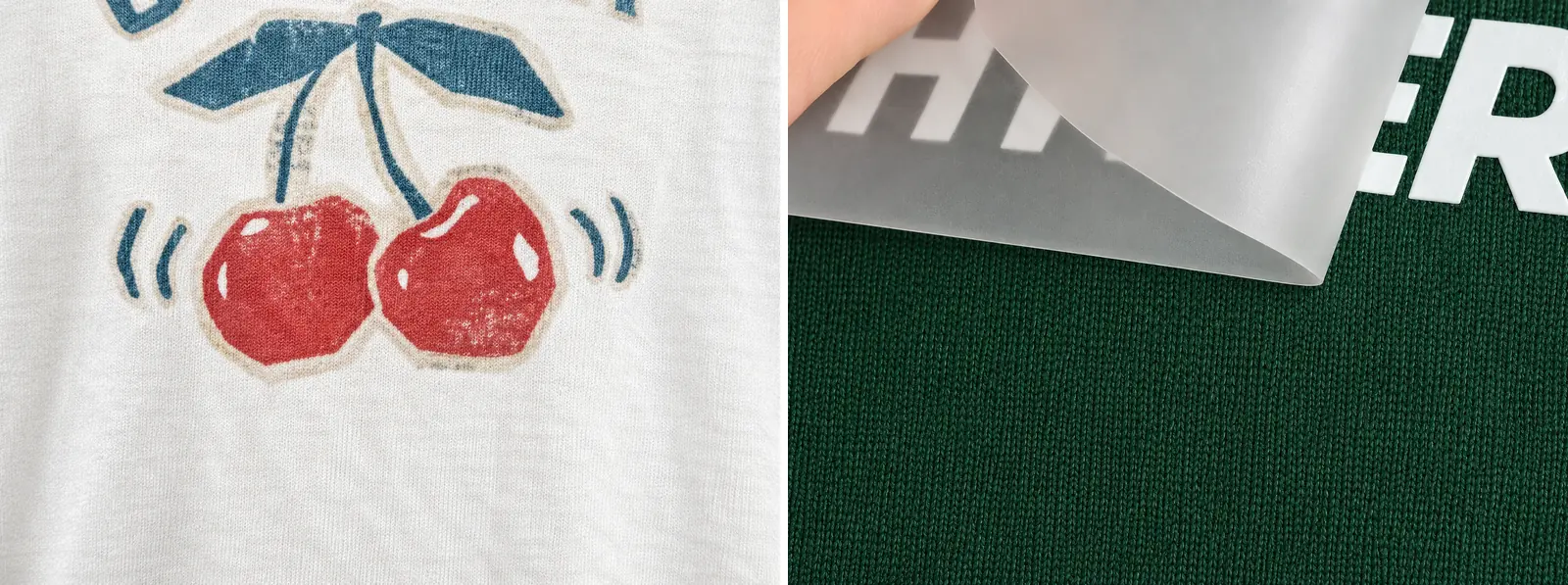
Rubber print and discharge print both work on dark garments, but they feel very different. Rubber print — the opaque, plastisol-type finish — lays a layer of ink on top of the fabric. It covers strongly and matches colours accurately, but it is thicker, breathes less, and shows a slight sheen under light. Keep large solid areas to a minimum if comfort matters.
Discharge print removes the garment dye where it prints, so the colour comes from the fabric itself and there is nothing on the surface to feel. It only works on 100% cotton, and the final shade is not fully predictable, which suits vintage and washed looks better than exact brand colours.
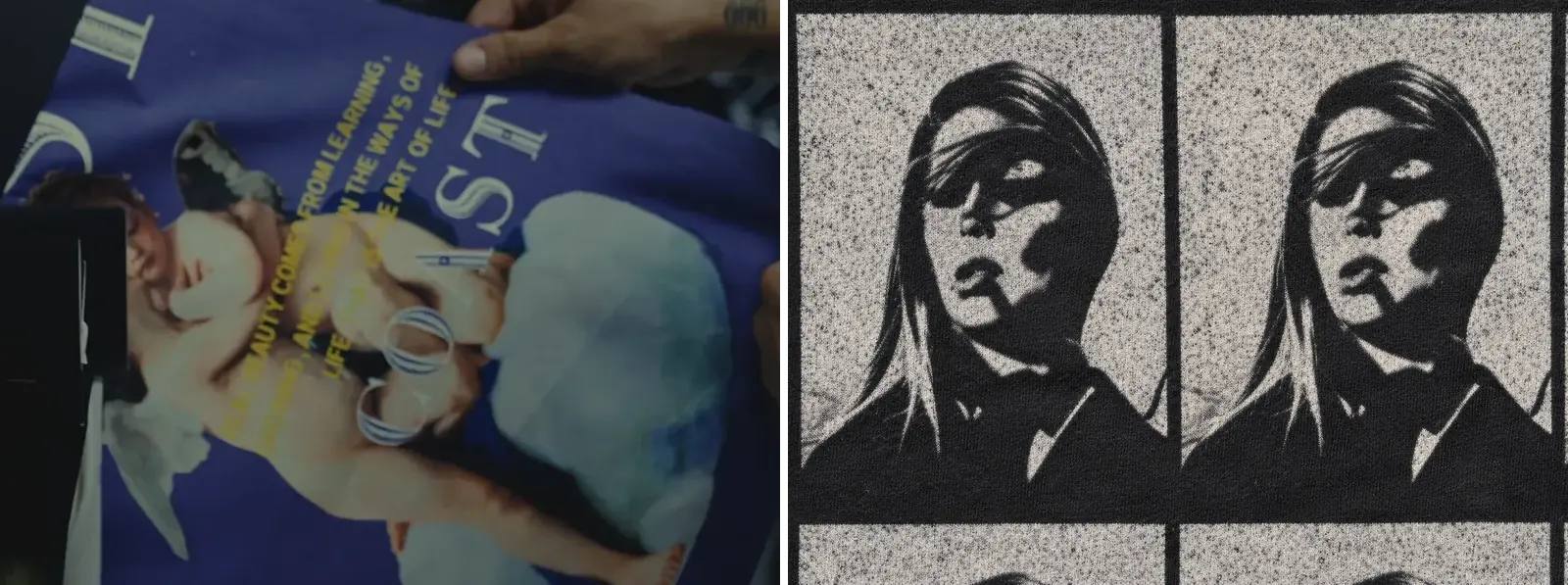
Plastisol-type vs water-based ink: what is the difference in handfeel?
Water-based ink sinks into the fibres and behaves much like dye, so the print feels almost like the fabric and keeps the garment breathable. Rubber, plastisol-type ink sits on top as a flexible film. If the brand promise is “soft and lightweight”, choose water-based on light garments or discharge on dark cotton. If the promise is “bright, exact colour”, choose rubber print and keep the area modest.
How do you add texture: puff, high-density or embroidery?
Choose puff print for rounded, playful lettering; high-density print for sharp, dimensional logos; and embroidery when the texture has to last for years. Puff print uses an additive that expands under heat, so thin strokes can swell and lose detail — bold shapes work best. High-density print builds thick ink through a deep stencil and keeps clean edges, but large solid areas feel heavy.
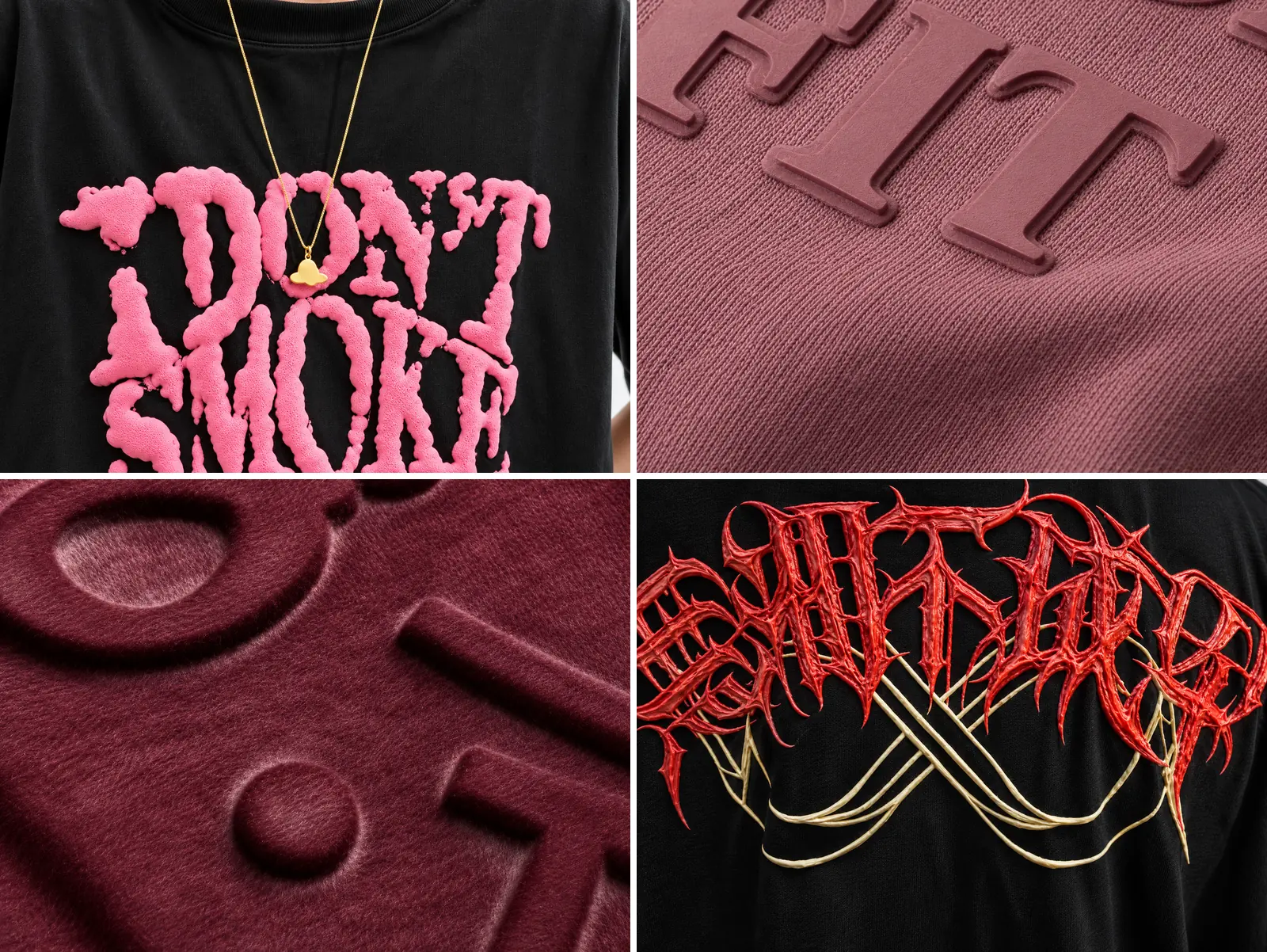
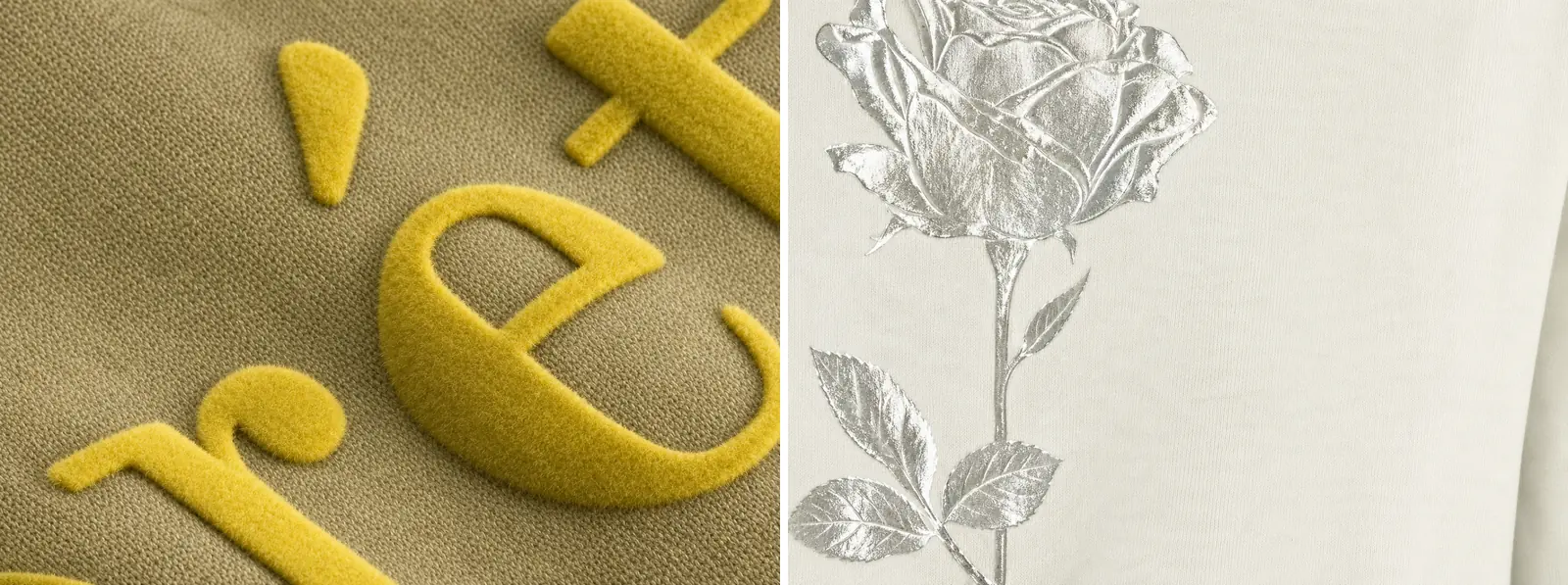
For relief with no ink at all, 3D heat embossing presses the design into the fabric with a mould; it suits tone-on-tone branding and holds best on polyester and blends. For an art piece where every print varies, textured lava print creates molten, dripping surfaces. Other surface finishes — flock for a velvety matte touch and gold or silver foil for a metallic shine — sit in the same family.
Which embroidery type fits your design?
Match the embroidery to the line weight and the mood of the artwork:
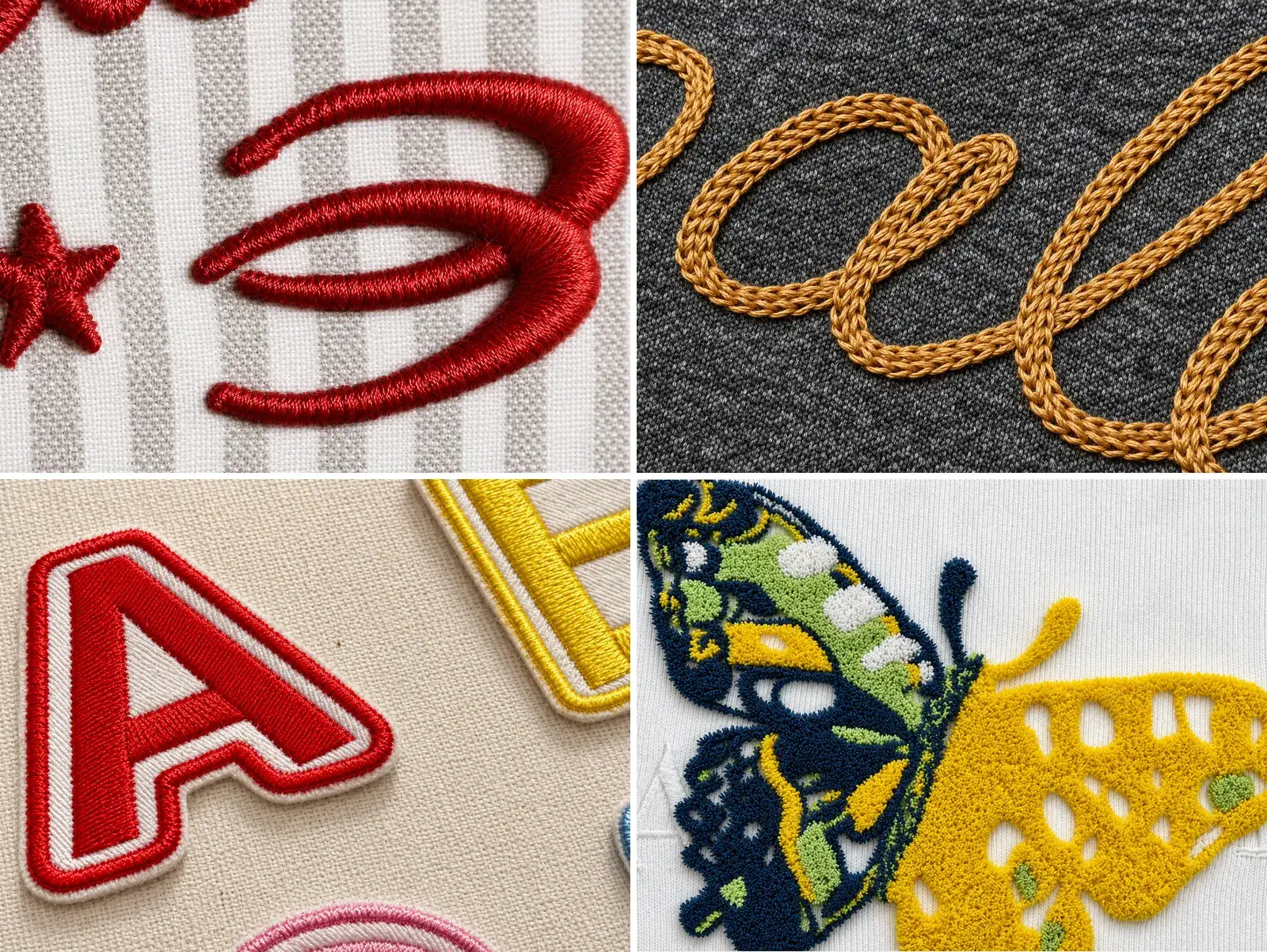
- Script logos and outlines: raised satin embroidery wraps stitches over a core cord for clean, rounded relief.
- Flowing line art, including on stretch knits: chain-stitch embroidery forms a flexible chain that gives slightly without breaking.
- Varsity letters and big badges: appliqué stitches pre-cut fabric shapes down, adding colour blocks without dense stitching.
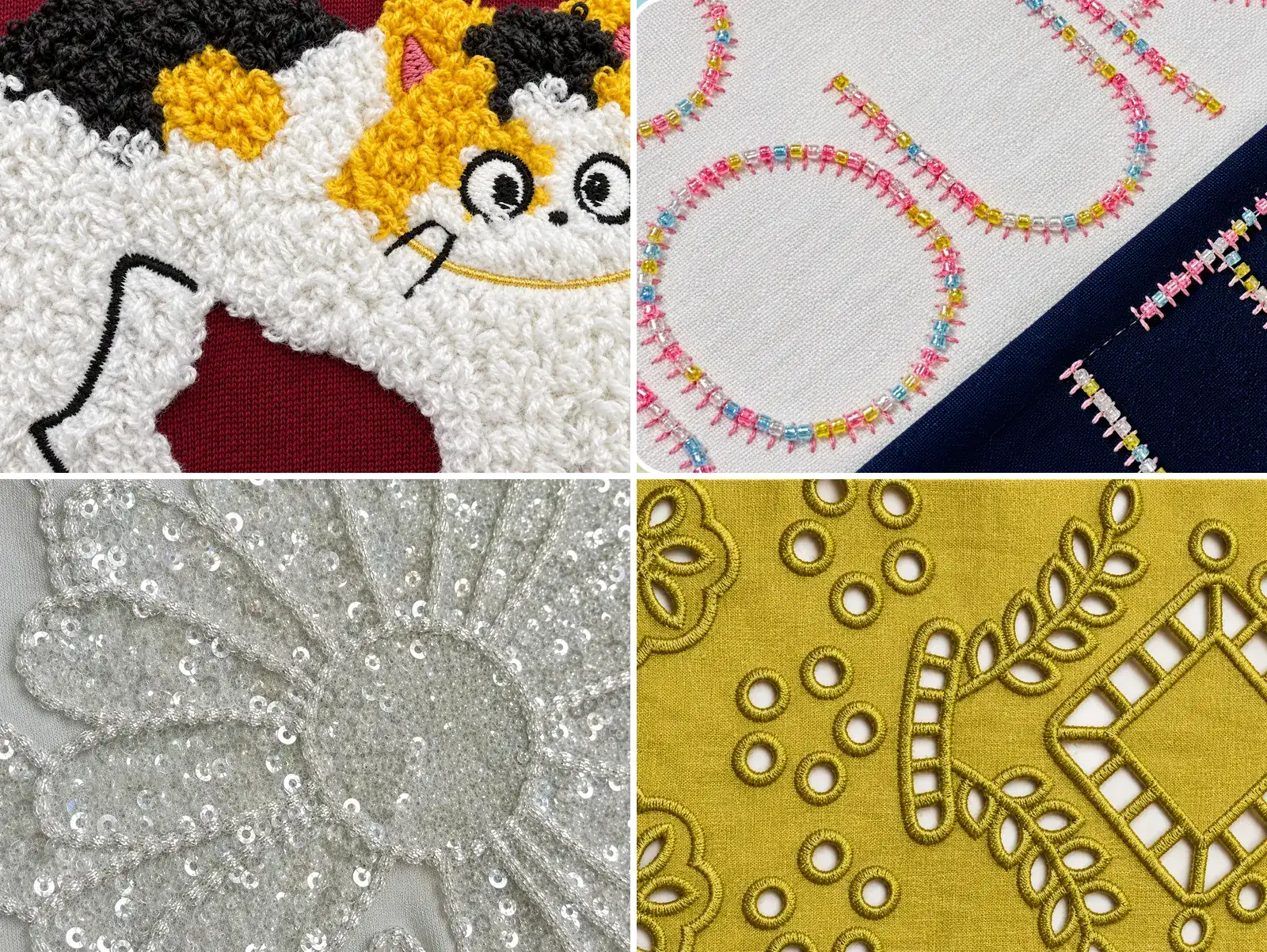
- Bold streetwear lettering: tufted embroidery leaves upright, brush-like threads, while chenille loop embroidery gives a softer, towel-like pile. Tufted reads sharper; chenille reads cosier.
- Decorative and occasion pieces: seed beads, sequins, cording and laser-cut embroidery add sparkle, vintage lines or open-work.
Embroidery cost follows stitch count and coverage, not colour count, so a small dense logo can cost more than a larger open outline. Very thin silk and mesh are poor bases for heavy embroidery; fleece, heavier knits, denim and canvas carry it well.
Snow wash, stone wash or salt wash: which garment wash do you need?
All four fade colour after the garment is sewn; they differ in pattern and intensity.
- Salt wash: graded salt tumbles with the garments for an even, natural fade and a softer hand. The most versatile wash for cotton, fleece and denim.
- Snow wash: treated pumice is tumbled without water, leaving irregular white, snowflake-like marks. Strong and visual; best on mid- to heavyweight cotton.
- Stone wash: pumice in plenty of water adds abrasion as well as fade, for a worn, vintage surface on denim, canvas and sturdy cotton.
- Spray wash: a fading agent is sprayed onto chosen zones, so you can control where the fade appears.
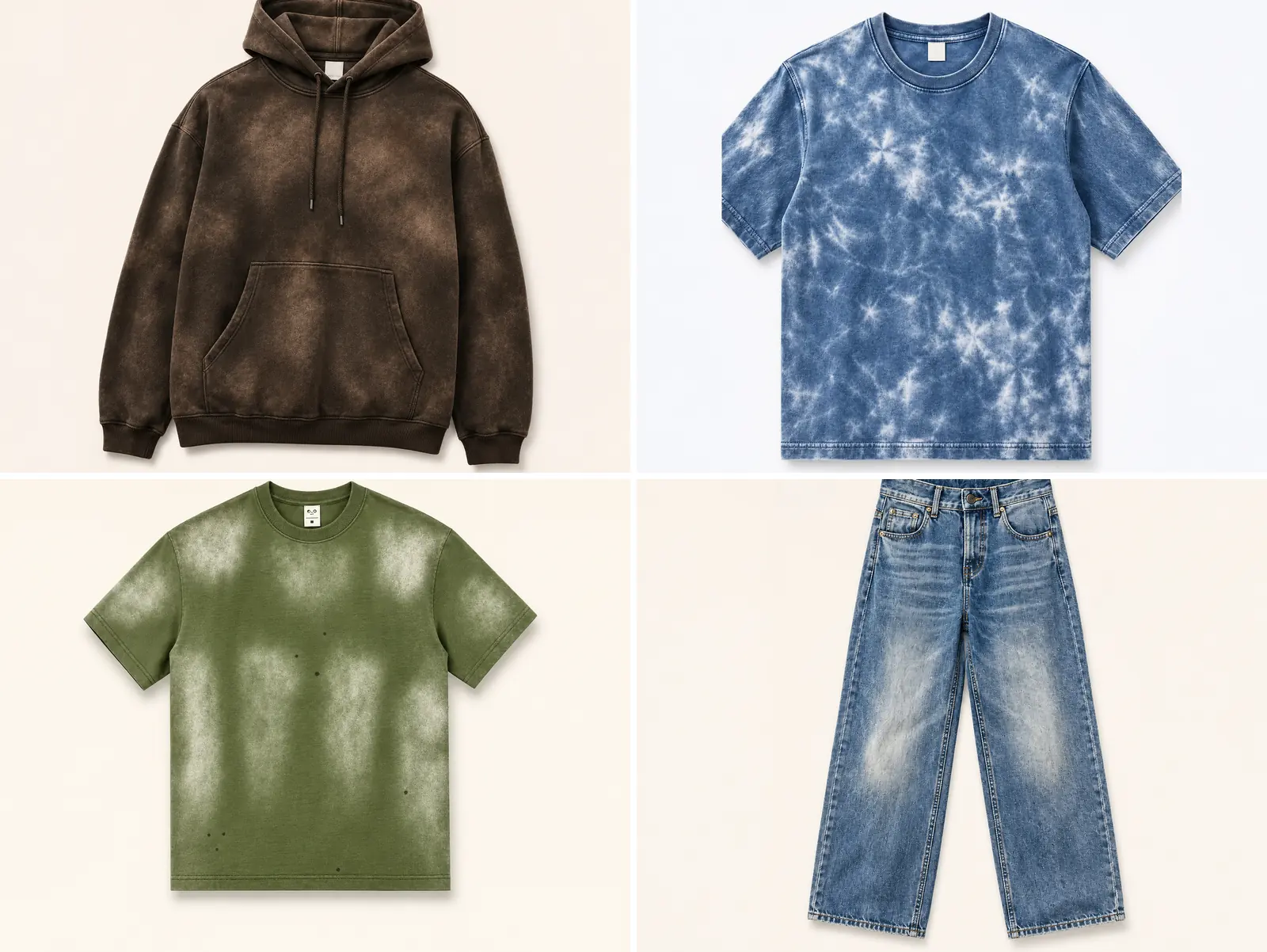
Every fabric reacts differently, so a wash is always confirmed on a sample before bulk.
Should you print before or after a garment wash?
Decide the order before sampling, because it changes the result. Printing after the wash keeps the artwork crisp and true to colour on a faded garment. Printing before the wash fades and softens the artwork along with the garment, which is how many vintage-style graphics get their worn look — but the wash also tests the print, so choose inks and stitches that survive it. Discharge and water-based prints age naturally through a wash; heavy rubber print and heat transfers are more likely to crack or lift. Tell us the look you want and we confirm the order on the sample.
What drives the cost of each method?
- Screen-based prints (screen, rubber, water-based, discharge, puff, high-density): one screen per colour, so colour count matters most.
- DTG and heat transfer: no screens; cost follows print size and ink coverage, which makes them practical for small or many-colour runs.
- Embroidery: stitch count, coverage and the number of thread changes.
- 3D heat embossing: a mould per design, then a low cost per piece.
- Specialty effects (lava, foil, flock, beads, sequins): extra material and often an extra sampling round.
- Washes: priced per garment and confirmed on a sample, because time, temperature and fabric set the result.
Quantity is set by the route, not the decoration. Your own designs start at 100 pieces per style; printing on our blank garments starts at 50. Washes belong to Custom Manufacturing, where the garment is developed with the wash in mind; printing and embroidery on ready blanks run through Customization.
How durable is each method, and how should it be cared for?
| Method | Handfeel | Dark garments | Durability | Care notes |
|---|---|---|---|---|
| Water-based print | Soft, breathable | No | Good colourfastness | Normal wash |
| Discharge print | Softest, nothing on surface | Yes (100% cotton) | Ages with the garment | Normal wash |
| Rubber print | Smooth film, slight sheen | Yes | Strong | Wash inside out, no hot iron on print |
| DTG print | Soft to medium | Yes, with white base | Good on high-cotton blanks | Wash inside out, low heat |
| Puff / high-density | Raised, rubbery | Yes | Can flatten with friction | Wash inside out |
| Heat transfer | Heavy, non-breathable | Yes | Can peel after many washes | Small areas only, inside out |
| Raised satin / chain-stitch | Raised thread | Yes | Very long-lasting | Cold, gentle, inside out |
| Tufted / chenille | Plush pile | Yes | Long-lasting; pile can crush | No tumble dry, iron with cloth |
| Washed garment | Soft, broken-in | — | Fade is permanent | Wash with similar colours |
How do you brief a decoration so the sample is right first time?
Send four things with the inquiry: the artwork file (vector for screen print, high-resolution for DTG), the garment and its colour, a reference for the look and handfeel you want, and the quantity per colour and size. We compare the suitable methods with our Guangdong partner print, embroidery and wash workshops, then confirm the route, minimum and price in the quotation. A digital proof, strike-off or decorated sample comes before bulk, so the decision is made on a real garment, not a screen. You can follow the full route on our production process page.
Frequently asked questions
Is screen printing or DTG cheaper?
For a simple design in a larger run, screen printing is usually cheaper per piece because the screen set-up is shared across the order. For a many-colour or photographic design, or a small test run, DTG is often cheaper because it needs no screens.
Does embroidery last longer than print?
Generally yes. Thread does not crack or peel like a printed film, so embroidery keeps its look for the life of the garment when washed cold and inside out. Plush types such as tufted and chenille can flatten if tumble-dried.
Can you print on a washed garment?
Yes. Printing after the wash keeps the artwork crisp on a faded base. Printing before the wash fades the artwork with the garment for a vintage look. We confirm the order on the sample.
What is the softest print for a dark T-shirt?
Discharge print, because it removes the dye instead of adding a layer. It needs a 100% cotton garment, and the final shade can vary slightly from piece to piece.